
The Formula Grants Program was established in the Juvenile Justice and Delinquency Prevention (JJDP) Act of 1974. It provides funds to help States, U.S. territories, and the District of Columbia implement a comprehensive State juvenile justice plan based on a detailed study of needs. (The term "States" as used throughout the remainder of this chapter refers to the 50 States, the District of Columbia, and the six U.S. territories of American Samoa, Guam, the Northern Mariana Islands, Palau, Puerto Rico, and the Virgin Islands.) The State plans must meet 25 statutory requirements, including four core requirements of the JJDP Act. The Act requires participating States to commit to (1) deinstitutionalizing status offenders and nonoffenders (the DSO requirement), (2) separating adult and juvenile offenders in secure facilities, (3) eliminating the practice of detaining or confining juveniles in adult jails and lockups, and (4) addressing the disproportionate confinement of minority juveniles in secure facilities where such overrepresentation exists. Most States are now in full compliance or in full compliance with de minimis exceptions with the first three requirements. Most States are also making satisfactory progress in meeting the fourth requirement concerning minority overrepresentation, which was added as a core requirement when the JJDP Act was amended in 1992.
The JJDP Act stipulates that if a State fails to comply with one or more of the core requirements, there will be a 25-percent reduction in the State's formula grant allocation for each requirement for which noncompliance occurs, and the State must agree to expend the remaining formula grant funds (with the exception of planning and administration funds, State Advisory Group funds, and Indian tribe passthrough funds) on efforts to achieve compliance. OJJDP is especially pleased that the States' progress in achieving and maintaining compliance with the core requirements, as documented in the FY 1998 updates of comprehensive 3-year plans, has enabled the States to use their formula grants to fund a variety of activities addressing delinquency prevention and other juvenile justice issues.
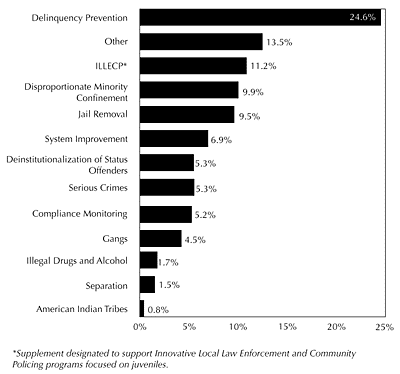
The program area receiving the greatest amount of funding in FY 1998 was delinquency prevention, with States spending more than $17 million (more than 24 percent of program dollars available from the Formula Grants Program). Another area receiving significant attention in FY 1998 was systems improvement, which received $5 million (nearly 7 percent of available funds). Systems improvement projects include initiatives to improve systems, policies, or procedures at all stages of the juvenile justice process, including arrest, detention, disposition, corrections, and aftercare. A full analysis of the allocation of FY 1998 formula grant funds by program area is presented in the chart below.
by Program Areas
(as of September 30, 1998)
During FY 1998, 57 jurisdictions (States, 6 territories, and the District of Columbia) were eligible for fund allocations under the Formula Grants Program. The States' eligibility to receive FY 1998 formula grants was partially determined on the basis of 1996 monitoring reports compliance with JJDP Act core requirements. Based on the 1996 monitoring reports, all States except three demonstrated partial or full compliance with the core requirements, and were eligible to receive funds during FY 1998. Kentucky, South Dakota, and Wyoming did not meet the requirements. (Kentucky's FY 1998 Formula Grant application was placed on hold per the State's request pending receipt of more current compliance monitoring data.) Details of Formula Grants Program compliance status within the core requirements are presented in the following discussion and in the charts below:
- State Compliance Based on 1996 Reports
- State Compliance Based on FY 1998 Formula Grants
Program Comprehensive Plan - Core Requirements Compliance Summary Totals
Each State's annual monitoring report on three of the four JJDP Act core requirements—DSO, separation, and removal from adult jails and lockups—is based on data the State collects from both juvenile and adult facilities. Data collection includes self-reporting to a State agency, onsite data collection and verification by a State agency, or a combination of these methods. All State agencies administering the JJDP Act Formula Grants Program are required to verify data that are self-reported by facilities or received from other State agencies.
The DSO provision of the JJDP Act stipulates that status offenders and nonoffenders cannot be detained or confined in secure detention or correctional facilities or adult jails or lockups. For 1998, 9 States had no violations and were in full compliance with the DSO provision, and 44 States were in full compliance with de minimis exceptions (fewer than 29.4 violations per 100,000 persons under age 18 in the State).
The separation provision of the JJDP Act requires that accused and adjudicated delinquent juveniles be separated from incarcerated adults and that status offenders and nonoffenders not be held securely in a jail or lockup for any length of time. For 1998, 37 States had no violations and were in full compliance with the separation provision, and 16 States were in compliance based on regulatory substantive de minimis criteria.
The jail and lockup removal provision of the JJDP Act stipulates that juveniles cannot be detained in any adult jail or lockup (exceptions are specified by statute and regulation). For 1998, 13 States had no violations and were in full compliance with this provision, and 36 States were in full compliance with de minimis exceptions (fewer than 9 violations per 100,000 persons under age 18 in the State).
Each State's compliance with the fourth JJDP Act core requirement—reduction of disproportionate minority confinement—is based on information provided in the State's FY 1998 Formula Grants Program comprehensive plan. This provision requires States to determine whether minority juveniles are disproportionately confined in secure detention and correctional facilities and, if so, to identify and programmatically address the underlying causes that account for the situation. As of FY 1998, 41 States have completed the initial identification and assessment phases for this provision and are implementing the intervention phase; 8 States, after completing the identification phase, have determined that minority youth are not disproportionately detained or confined in their facilities.
| Previous | Contents | Next |
 | ||
| OJJDP Annual Report 1998 | October 1999 | |