Identifying Underlying Factors
Devising appropriate, community-based DMC intervention strategies requires an accurate assessment of the factors that contribute to minority overrepresentation. Because the contributing factors are known to be complex and interrelated, all key system representatives must be consulted and engaged in the problem-solving process.
Although specific activities varied, the pilot States all used a similar approach to identify factors that potentially contribute to DMC. The DMC Phase I assessment activities and the early Phase II planning activities included extensive data gathering and opinion polling about the evidence of DMC and perceived reasons for its occurrence. Once potential DMC contributing factors had been identified, each State DMC coordinator synthesized his or her respective information and attempted to develop consensus about the most critical factors, which could then be addressed through DMC interventions.
The Phase I analysis indicated that the extent of DMC varied among counties and/or local jurisdictions. Each State, therefore, targeted its DMC efforts in a location showing the highest rates of overrepresentation and/or the largest minority populations. DMC coordinators focused their attention on these areas to identify all possible contributing factors.
Gather Information on Potential Contributing Factors
The DMC coordinators employed several information-gathering strategies to expand the understanding of DMC within specific communities and for the State as a whole. These strategies included:
- Public forums, hearings, and town hall meetings with representatives of the juvenile justice system and of education, social service, civic, religious, and community groups.
- Interviews and mail surveys of staff and managers within juvenile justice agencies.
- Interviews with minority juveniles and their families.
- Case record reviews within local juvenile justice agencies.
 Information collected from public meetings, surveys, interviews, and case records revealed a wide array of perceptions about DMC contributing factors, which covered the gamut from systemic racism to criminal predilection. In other words, perceptions of DMC causes ranged from “blaming the system” to “blaming the individual” or, as some would argue, “blaming the victim.” The fact that those involved with or touched by DMC hold such extremely divergent views necessitated a full analysis and synthesis of the factors identified and then consensus-building among these individuals.
Synthesize Contributing Factors
Although perceptions of the factors that contribute to DMC varied within and between local communities, the inventory of all possible factors was consistent across the five pilot States. The overall list of contributing factors generally fell into four interrelated domains:
- The juvenile justice system.
- The educational system.
- The family.
- Socioeconomic conditions.
Examples of the contributing factors in each of these domains and their interrelationships are illustrated in figure 1 and described below.
The Juvenile Justice System. Community representatives from each of the pilot States, including minority juveniles and their families, identified racial/ethnic bias within the juvenile justice system as contributing to DMC. Typically, this bias was viewed as unintentional rather than overt. For example, many State-level participants concluded that societal biases were mirrored in the juvenile justice system, resulting in minority overrepresentation. Other examples of juvenile justice system contributing factors included the lack of adequate diversion programs for minority juveniles, the lack of culturally appropriate juvenile services, a lack of cultural understanding among juvenile justice system staff, and perceived barriers to parental advocacy because of minority parents’ often limited understanding of the system.
The Educational System. All of the local community representatives identified some aspect of the educational system as contributing to DMC. Opinions diverged, however, when attributing causality. In general, perceptions focused on either the failure of schools to adequately serve minority juveniles or the failure of minority juveniles to fully participate in the educational system. Specific examples of educational system failings included inadequate early childhood education, inadequate programs to prevent students from dropping out early, and a lack of appropriate cultural education, together with minority juvenile truancy, suspensions, and expulsions.
The Family. The most sensitive and controversial of factors believed to contribute to DMC were family composition and family functioning. Single-parent families and their often associated high poverty levels were recognized as potential contributing factors, because justice-involved minority juveniles reside disproportionately in single-parent, low-income households. State data also indicate that minority juveniles receive more out-of-home placements than do majority juveniles, partly because of perceptions that minority family home environments are less stable. Similarly, the lack of strong family support may contribute to juveniles’ succumbing to negative peer pressure, including gang involvement, substance abuse, and other delinquent behaviors, which, in turn, may contribute to increased delinquent behaviors.
Socioeconomic Conditions. A majority view held that economic and/or social conditions contribute to DMC. Perceived economic factors include the higher likelihood of low incomes, few job opportunities, and urban density among minority families. Contributing social factors include a lack of cultural awareness among the majority community, coupled with a lack of positive role models and social opportunities for minority juveniles, and limited social support services in minority neighborhoods.
Taken together, these four overarching domains—the juvenile justice and educational systems, the family, and prevailing socioeconomic conditions—provide a framework for identifying the underlying causes of minority overrepresentation, as illustrated in figure 1. This initiative and other research demonstrate that minorities are disproportionately affected by poverty and that educational systems do not adequately serve minority juveniles. The data also clearly show that racial bias exists in some juvenile justice systems, if only because of inadequate cultural awareness. Although causality cannot be ascribed, minority juveniles tend to be disproportionately subjected to multiple social, economic, and educational stressors. To the extent that these stressors contribute to negative behaviors, and if the juvenile justice decisionmaking process is in any way influenced by racial/ethnic characteristics, then disproportionate minority involvement in the juvenile justice system will result.
|
Figure 1: Underlying Factors That Contribute to Minority Overrepresentation 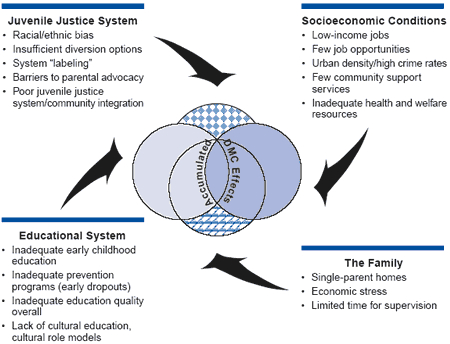
Click here for detail explanation.
|
Build Consensus About Contributing Factors
Although individuals’ opinions varied as to specifics, significant agreement existed among all participants that DMC is associated with multiple underlying factors that must be addressed with multiple interventions. The consensus-building process that was employed in the pilot States was extremely important in moving groups of diverse individuals toward common understanding and agreement on these highly sensitive DMC issues. The process of listening to, hearing, and addressing individual concerns helps to neutralize divergence and enables disparate community representatives ultimately to work together on strategies to address their DMC problem. All members of the community are needed for the successful implementation of solutions to DMC, and using an inclusive approach encourages each of the diverse players to contribute to the solution. Specifically, inclusion helps to keep State-level participants involved in monitoring progress and offering appropriate technical assistance and to keep community-level participants involved in ensuring client-level “buy in” and participation.
|
State Profile: Iowa
|
| Previous | Contents | Next |
 |
|
| Disproportionate Minority Confinement: Lessons Learned From Five States | |