|
Juvenile arrests
disproportionately
involved minorities
The racial composition of the juvenile population
in 2000 was 79% white, 16% black,
4% Asian/Pacific Islander, and 1% American
Indian. Most Hispanics (an ethnic
designation, not a race) were classified as
white. In contrast to their representation
in the population, black youth were overrepresented
in juvenile arrests for violent
crimes, and, to a lesser extent, property
crimes. Of all juvenile arrests for violent
crimes, 55% involved white youth, 42%
involved black youth, 2% involved Asian
youth, and 1% involved American Indian
youth. For property crime arrests, the proportions
were 69% white youth, 27% black
youth, 2% Asian youth, and 1% American
Indian youth.
|
Most Serious
Offense |
Black Proportion of
Juvenile Arrests in 2000 |
|
|
| Murder | 50% |
| Forcible rape | 35 |
| Robbery | 56 |
| Aggravated assault | 37 |
| Burglary | 25 |
| Larceny-theft | 26 |
| Motor vehicle theft | 41 |
| Weapons | 31 |
| Drug abuse violations | 28 |
| Curfew and loitering | 25 |
| Runaways | 18 |
|
Data source: Crime in the United States 2000,
table 43.
|
Converting arrest counts to arrest rates
(i.e., arrests/100,000 juveniles in the racial
group), the Violent Crime Index arrest rate
in 2000 for black juveniles (555) was nearly
4 times the rate for American Indian juveniles
(151) and white juveniles (146), and
7 times the rate for Asian juveniles (75).
For Property Crime Index arrests, the rate
for black juveniles (1,885) was two-thirds
greater than the rate for American Indian
juveniles (1,149), about double the rate for
white juveniles (958), and about 4 times
the rate for Asian juveniles (512).
|
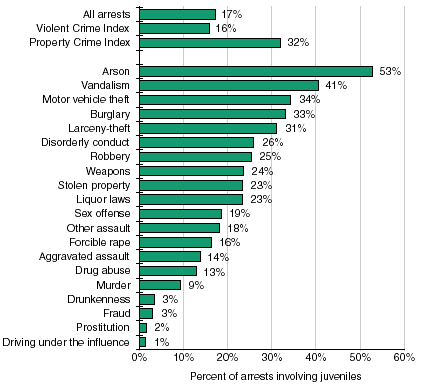
In 2000, juveniles were involved in about 1 in 11 arrests for murder,
1 in 8 arrests for a drug abuse violation, and 1 in 3 arrests for burglary
or motor vehicle theft |
|
|
| Data source: Crime in the United States 2000 (Washington, DC: U.S. Government Printing
Office, 2001), table 38.
|
|
|
|
|
Juvenile Arrests 2000 |
OJJDP Bulletin • November 2002 |
|