|
| ||
|
Chapter 3 Strengthening the Juvenile Justice System In keeping with its role of providing national leadership in juvenile justice and delinquency prevention, OJJDP continually strives to help improve the juvenile justice system and the way it responds to juvenile delinquents, status offenders, and victimized children. During FY 2000, the Office supported a number of programs that are helping to strengthen juvenile justice systems across the country. The oldest of these programs, the Formula Grants program, has been providing block grants to States since 1975 to help them develop and implement comprehensive State juvenile justice plans based on detailed studies of needs. OJJDP also oversees several programs that recognize the importance of holding youth accountable for violating the law and providing youth with rehabilitation services. Many States and communities find themselves struggling with detention and corrections issues, and OJJDP is funding several initiatives to help jurisdictions address these issues. One of these initiatives provides training on how to plan for the construction or renovation of, and programming for, facilities. Another is helping juvenile detention and correctional facilities implement operating standards and conduct self-evaluations to monitor implementation. OJJDP also sponsors a number of training and technical assistance activities that address the needs of juvenile justice practitioners (such as law enforcement professionals, prosecutors, educators, and social service professionals) and communities. To make it easier for the field to access information about these activities, OJJDP has established a National Training and Technical Assistance Center. The Office also developed a number of new programs to address juvenile justice system issues. One of these programs will identify and examine the principal reasons behind the statistical trends in juvenile crime and violence. OJJDP continues to develop and fund a variety of programs to help strengthen the juvenile justice system. The activities highlighted in this chapter illustrate the types of programs that are under way. Balanced and Restorative Justice During FY 2000, OJJDP continued to support the Balanced and Restorative Justice (BARJ) project, which promotes increased use of restitution, community service, victim-offender mediation, and other innovative programs designed to hold juvenile offenders accountable and protect the community while, at the same time, developing the competency of juveniles. Through its grantee, Florida Atlantic University (FAU) in Fort Lauderdale, FL, OJJDP provides training, technical assistance, and information/resources to States and local jurisdictions interested in implementing BARJ programs. In recent years, the BARJ project has reached justice system managers and practitioners in every State, resulting in innovative restorative justice activity across the Nation. The project has developed both basic and advanced BARJ training curriculums (in cooperation with the National Institute of Corrections) and produced several BARJ resource documents, including the Guide for Implementing the Balanced and Restorative Justice Model, Balanced and Restorative Justice for Juveniles: A Framework for Juvenile Justice in the 21st Century, and Restorative Justice Inventory: An Organizational Assessment for Juvenile Justice Agencies. The Guide for Implementing the Balanced and Restorative Justice Model is available from the Juvenile Justice Clearinghouse. The other publications are available from FAU. In addition, project staff and consultants have written articles about BARJ for numerous professional periodicals. During FY 2000, BARJ staff and consultants presented more than 25 training and technical assistance events. Notable among these were a number of roundtables for judges, juvenile justice administrators, and representatives of States interested in implementing BARJ. The roundtables are designed to train from 30 to 40 local juvenile justice leaders. BARJ staff also held forums on changing roles for juvenile probation, prosecutor involvement in restorative justice, and strength-based rehabilitation and competency development. In cooperation with OJJDP�s Juvenile Accountability Incentive Block Grants program and the National Institute of Corrections, BARJ staff and consultants also delivered two �train the trainers� courses and a course on basic BARJ principles. Since 1998, the project grantee has organized or made presentations at more than 100 events, which were attended by more than 10,000 practitioners. Many communities are searching for more effective and efficient methods to identify and intervene with juveniles at risk of becoming serious, violent, and chronic offenders. Research has demonstrated that delinquent youth often face multiple risk factors and that, as risk factors accumulate, higher levels of delinquency and other problem behaviors result. Consequently, youth with these problems are often involved with several different systems (e.g., juvenile justice, mental health, and/or alcohol and other drug treatment) that may not communicate adequately with one another. OJJDP�s Community Assessment Center (CAC) program currently is helping two communities—Denver, CO, and Orlando, FL—test the efficacy of the CAC model in addressing these problems. (OJJDP originally funded four sites: Denver and Jefferson County, CO; and Fort Myers and Orlando, FL.) The main purpose of a CAC is to facilitate earlier and more efficient delivery of prevention and intervention services at the front end of the juvenile justice system. During FY 2000, Human Service Associates, Inc., of Orlando and the Denver Juvenile Court each worked to develop a fully operational CAC that includes the following four components:
OJJDP also continued to fund an intensive process and outcome evaluation of the sites through the National Council on Crime and Delinquency (NCCD) of San Francisco, CA. NCCD has completed the process evaluation of the four community assessment centers originally funded by OJJDP and is continuing an outcome evaluation of the Denver and Orlando sites. The evaluators also will conduct a national survey of CACs to identify and describe different concepts being implemented. An OJJDP Bulletin, The Community Assessment Center Concept, describes this program. The Bulletin is available from the Juvenile Justice Clearinghouse. The Formula Grants program, which was established by the Juvenile Justice and Delinquency Prevention (JJDP) Act of 1974, is the core program supporting State and local program planning and implementation. This program provides funds directly to States, U.S. territories, and the District of Columbia to help them implement comprehensive State juvenile justice plans based on detailed studies of needs in their jurisdictions. (The term �States� as used throughout the remainder of this discussion refers to the 50 States, the District of Columbia, and 5 U.S. territories: American Samoa, Guam, Northern Mariana Islands, Puerto Rico, and the Virgin Islands.)
During FY 2000, $76,540,000 was available for direct awards to States. Allocations are based on the number of juveniles in a State and ranged (other than for territories) from $638,000 (Washington, DC) to $8.4 million (California). The Governor of each State designates the State agency that implements the Formula Grants program. Contact information for each State�s administering agency for Formula Grants and other grants can be found at www.ojp.gov/state.htm. Although the awards go to this agency, the JJDP Act requires that two-thirds of all Formula Grant funds be passed through to programs of units of general local government, local private agencies, and Indian tribes that perform law enforcement functions. To participate in the Formula Grants program, a State must address 25 State planning requirements set forth in the JJDP Act and must comply with 4 core protections for juveniles involved in the justice system:
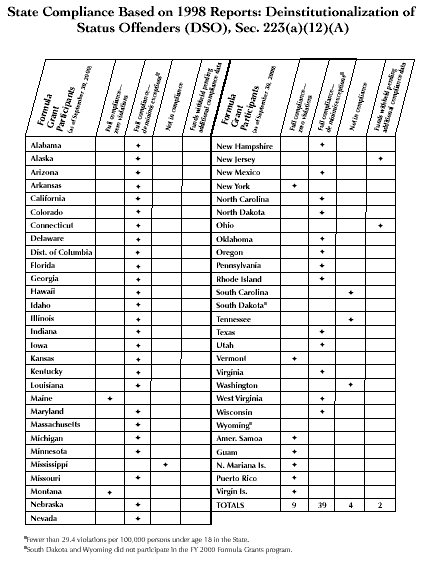
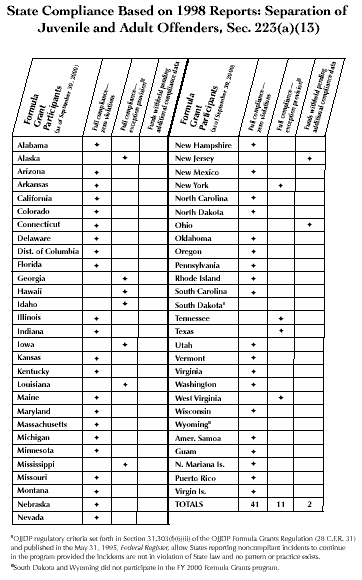
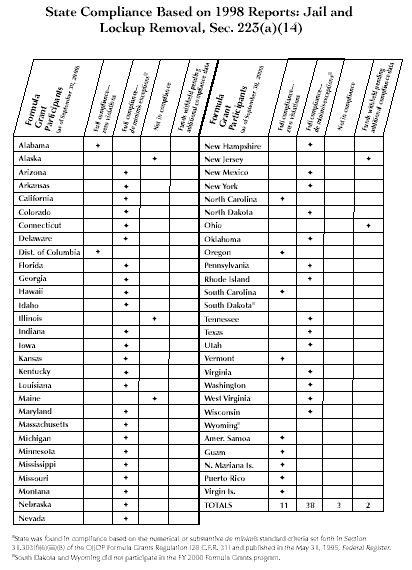
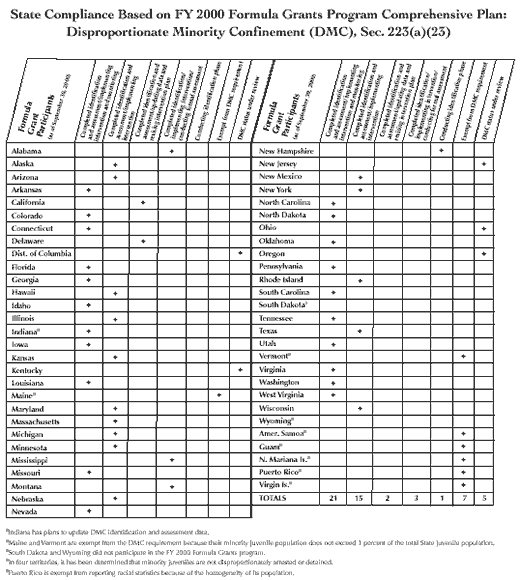
Under OJJDP�s leadership, States are making tremendous strides in achieving or maintaining compliance with these core protections. The vast majority of the 54 States participating in the Formula Grants program (South Dakota and Wyoming are not participating) are now in full compliance (or in full compliance with de minimis exceptions) with the first 3 requirements and are making satisfactory progress in meeting the DMC requirement, which was added as a core protection when the JJDP Act was amended in 1992. Most States have completed the initial identification and assessment phases for this provision and are implementing the intervention phase. Twenty of these States have submitted updated DMC data, evidencing ongoing monitoring efforts. Details of individual States� compliance with the core protections of the JJDP Act are presented in the charts. Interstate Compact on Juveniles The Interstate Compact on Juveniles (ICJ) is a multi-State agreement—a legal contract involving all 50 States, the District of Columbia, the Virgin Islands, and Guam—that provides a procedural means to regulate the movement across State lines of juveniles who are under court supervision. It is estimated that ICJ handles the transfer and supervision across State lines of more than 40,000 juvenile offenders and nonoffenders annually. During FY 2000, OJJDP, in cooperation with the National Institute of Corrections, funded a survey of juvenile justice professionals who are familiar with ICJ to assess the strengths and weaknesses of the Compact. Survey results identified common problems with the Compact and provided recommendations for improvements. OJJDP and the Council of State Governments of Lexington, KY, organized an advisory group of representatives from juvenile justice, probation and parole, victims advocacy, law enforcement, health and human services, and judiciary organizations to assess and determine a future course of action with regard to modifying ICJ to enhance its effectiveness. The group�s recommendations are expected in June 2001. A Fact Sheet, Interstate Compact on Juveniles, is available from the Juvenile Justice Clearinghouse. Juvenile Accountability Incentive Block Grants Program The Juvenile Accountability Incentive Block Grants (JAIBG) program, first funded in FY 1998, is helping to strengthen the juvenile justice system by encouraging States and local jurisdictions to implement accountability-based programs and services. Under the program, OJJDP awards block grants to States, which in turn pass through at least 75 percent of the funds (absent a waiver) to local jurisdictions. JAIBG also supports program-related research, demonstration, evaluation, training, and technical assistance activities. During FY 2000, 56 eligible jurisdictions (50 States, 5 U.S. territories, and the District of Columbia—hereinafter referred to as �States�) received JAIBG awards. The awards can be used to fund programs in 12 purpose areas, listed in JAIBG Program Purpose Areas. To help States and local jurisdictions implement JAIBG programs, OJJDP provides training and technical assistance through a grant to Development Services Group, Inc. (DSG), of Bethesda, MD. Since 1998, DSG staff have filled more than 200 technical assistance requests; conducted 64 training events, presentations, and workshops; and trained more than 2,800 individuals across the Nation. During FY 2000, the training program featured six regional training conferences for State and local JAIBG grantees. Each conference included a 3-day program of 20 workshops and presentations customized to the needs of the region. From 100 to 125 participants attended each conference. DSG also held focus group meetings to identify training needs on the subjects of juvenile sex offenders and management information technology and also sponsored two �train the trainers� programs. DSG is currently implementing a JAIBG topical training program based on the identified needs of communities. Topics of this new training program include graduated sanctions, law enforcement programs for schools, information technology, risk assessment, court programs (such as youth, gun, and drug courts), and the balanced and restorative justice approach. During the past 2 years, DSG has produced more than 50 surveys, reports, newsletters, and other information products. For example, at OJJDP�s request, DSG assessed training and technical assistance needs for the JAIBG program. In addition, DSG staff contacted all States and territories five times during the past 2 years to take a �snapshot� of their progress in implementing the JAIBG program. DSG also provides information services to JAIBG stakeholders through a quarterly newsletter, a listserv, and a toll-free telephone number—877–GO–JAIBG (877–465–2424). As part of its technical assistance responsibility, DSG also coordinates the JAIBG National Training and Technical Assistance Alliance, a group of 18 OJJDP grantees that provide training and technical assistance to States and localities to help implement the JAIBG program. This streamlined approach provides a single point of contact for States and local jurisdictions. Alliance members have conducted more than 300 training events, workshops, presentations, and videoconferences, providing a total of 148,000 hours of JAIBG-related training to nearly 19,000 practitioners. Alliance members have developed 179 products that address topics such as drug courts, youth courts, training for newly assigned prosecutors and detention and corrections facility staff, drug testing, model youth accountability programs, and balanced and restorative justice strategies. One example of these broad-based training efforts is the American Prosecutors Research Institute�s Jumpstart program, which is designed to meet the training needs of prosecutors newly hired with JAIBG funds, promoting an understanding of their responsibilities in prosecuting juvenile cases and offering information on practical skills and experiences to enhance prosecutorial effectiveness. In addition to the training and technical assistance provided by DSG, OJJDP and the U.S. Department of Justice�s Bureau of Justice Statistics established the JAIBG Technical Support Center to help States gather information needed to ensure the proper allocation of JAIBG funds to local jurisdictions. Operated by the Justice Research and Statistics Association of Washington, DC, the Center provides States with the latest crime and expenditure data needed to calculate JAIBG allocations. OJJDP also continued to publish a series of JAIBG Bulletins that present up-to-date information about each of the JAIBG program purpose areas. During FY 2000, the following Bulletins were published:
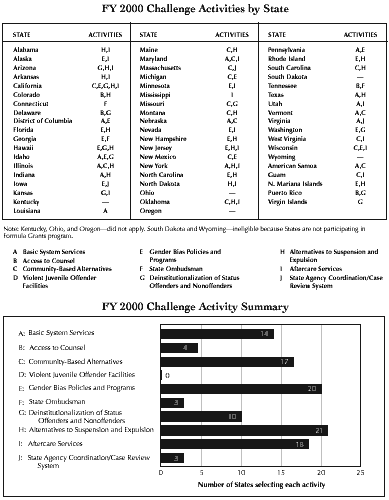
The Bulletins are available from the Juvenile Justice Clearinghouse. Abt Associates Inc., of Cambridge, MA, began conducting a 48-month national process evaluation of the JAIBG program in FY 2001. Researchers will document how the program was administered, how grants were used by State and local recipients, and what types of programs were funded. They also will document State and local programs� access to and use of training and technical assistance, practitioners� and policymakers� attitudes about the JAIBG program, and States� responses to JAIBG purpose areas. Evaluators also will conduct mail surveys of State and local practitioners and policymakers concerning their attitudes about the JAIBG program and perceptions of how it was implemented in their jurisdictions. National Juvenile Corrections and Detention Forum The American Correctional Association of Lanham, MD, conducts an annual National Corrections and Detention Forum under a grant from OJJDP. The Forum allows juvenile justice leaders from across the country to exchange information and network with their peers. Each State director of juvenile corrections, along with a detention center director, is invited to attend the Forum to learn about emerging issues, best practices, changes in laws, and court decisions affecting State and local departments of juvenile corrections and detention. Each year, the Forum agenda reflects current topical issues facing the juvenile justice system. The theme of the 2000 Forum, held in May in Albuquerque, NM, was Mental Health Issues in Juvenile Corrections. Forum topics included methods of identifying and screening mentally ill juveniles, risk assessments, promising practices, and suicide prevention. More than 150 individuals attended the Forum. The 2001 Forum was held in San Diego, CA, on May 5—8; the theme was Correctional Education in the Juvenile Justice System. National Training and Technical Assistance Center Practitioners in the field of juvenile justice and delinquency prevention face enormous challenges in their efforts to change existing practices in ways that will improve outcomes. Because quality training and technical assistance (T&TA) can facilitate such efforts, OJJDP established the National Training and Technical Assistance Center (NTTAC) in 1995. Operated by Caliber Associates of Fairfax, VA, the Center coordinates the services of more than 60 OJJDP T&TA providers. The Center also identifies and assesses T&TA resources in the field, collects and provides access to the best available T&TA materials, develops new T&TA materials, and disseminates model T&TA protocols and guides. During FY 2000, NTTAC responded to more than 427 T&TA requests, collected more than 1,300 resources about T&TA best practices, and recorded more than 5,000 visits on its Web site (www.nttac.org). NTTAC also produces a number of products, including a bimonthly newsletter, Fact Sheets, and Bulletins. During FY 2000, the Center updated and published the OJJDP Training and Technical Assistance Resource Catalog (2000 Edition), one of its major products. The catalog contains comprehensive information on some 100 OJJDP-sponsored T&TA projects, including scope, services, and contact information. A Fact Sheet, OJJDP National Training and Technical Assistance Center, is available from the Juvenile Justice Clearinghouse. Information about NTTAC�s products and services also is available by calling 800–830–4031 or visiting the Web site. Performance-based Standards Project OJJDP launched the Performance-based Standards (PbS) project in 1995 in response to findings from its landmark 1994 study, Conditions of Confinement: Juvenile Detention and Correction Facilities, which identified several factors related to high rates of injury to staff and youth and high levels of staff turnover in juvenile correctional facilities. These factors include high rates of suicidal behavior by youth in residential placement, lack of timely and professionally conducted health screenings, and pervasive overcrowding. Recognizing the need for national performance standards to improve the quality and conditions of such facilities, OJJDP awarded a grant to the Council of Juvenile Correctional Administrators of South Easton, MA, to establish outcome measures and data elements for measuring the impact of six PbS goals in the areas of security, order, safety, programming, justice, and health/mental health. Performance-based standards appear to be making a difference in the quality of service. Since August 1998, 32 juvenile facilities have served as test sites for the standards. These facilities have completed four rounds of data collection and were continuing to work on improvements prior to the next round, which is scheduled to begin in spring 2001. Since beginning implementation, facilities have reported positive changes. These were measurable, tangible improvements, such as reductions in youth injuries and staff turnover. One facility, which had experienced a youth suicide and major criticism from the media, policymakers, and the public, showed substantial improvement just 1 year after implementing its PbS project. The facility�s data report showed that all youth were now being screened at intake for risk of suicide before being assigned housing and that there had been no suicides during the year. The evaluation also showed a reduction in the use of mechanical restraints and indicated that no injuries to youth had occurred when restraints were used. Over the same period, the facility�s use of isolation and room confinement was cut in half, and fewer injuries to youth and fewer escapes occurred. Each of these areas had been the subject of public criticism and had been targeted for improvement. Through an interagency agreement with the U.S. Department of Commerce, OJJDP also is supporting an evaluation of the PbS project. The evaluation is being conducted by the National Academy of Public Administration of Washington, DC. Recent survey results from the evaluation continue to be positive, in terms of both the adoption of PbS and improvements in facility outcomes. Even though nearly one-third of facilities reported significant difficulties with initial implementation, they felt strongly that the standards would ultimately be accepted and benefit youth correction and detention facilities. Researchers confirmed that PbS goals are widely shared by facility administrators and staff. During FY 2000, 26 additional facilities volunteered to participate in the PbS project and began an intensive orientation and training process. OJJDP also expanded the scope of PbS by focusing on the critical goal of facilitating effective reintegration of youth back into their communities. The PbS project team is working with OJJDP�s Intensive Aftercare Program (IAP) team to integrate IAP concepts and appropriate measures into the PbS project. Planning of New Institutions for Juveniles A few years ago, it became evident through studies such as OJJDP�s Conditions of Confinement: Juvenile Detention and Correction Facilities that because of widespread crowding and substandard conditions in juvenile facilities across the country, many facilities had to be replaced or renovated. Recognizing the need to help jurisdictions plan for the construction or renovation of juvenile facilities, OJJDP and the U.S. Department of Justice�s Corrections Program Office (CPO) approached the National Institute of Corrections (NIC) about developing workshops for officials planning to build or renovate juvenile facilities. The resulting Planning of New Institutions for Juvenile Facilities (Juvenile PONI) workshop program helps jurisdictions make well-informed planning decisions about building new secure juvenile facilities or about renovating or expanding existing facilities. OJJDP and CPO provide the funding for this program and NIC oversees development and presentation. The Juvenile PONI program, which is funded in part through OJJDP�s JAIBG program (see Juvenile Accountability Incentive Block Grants Program), represents an important commitment by the three sponsoring Federal agencies to devote special attention to juvenile confinement facilities. Participating jurisdictions select six-person teams to attend PONI workshops. Each team must include officials with statutory responsibility for funding, operation, and administration of the facility to be constructed or renovated. Other members might include judges, program administrators, citizens, financial officers, and/or architects and planners under contract to the jurisdictions. The 5-day Juvenile PONI curriculum is organized into 16 modules. Several of the modules—including a historical overview of juvenile justice management and attitudes, an overview of the facility development process, and aspects of direct supervision—use a conventional lecture-discussion format. Other modules, such as clarifying team roles, framing a vision statement, developing functional space programs, and relating staffing plans to facility plans, use break-out sessions that require hands-on teamwork and result in an on-the-spot work product. The workshops also emphasize that secure facilities should be part of a system of graduated sanctions to ensure swift treatment of juveniles that is appropriate to the seriousness of their offenses. The first Juvenile PONI workshop was conducted in November 1998. Since then, the sponsoring agencies have offered three workshops each year, with five to six jurisdictions participating in each session. An OJJDP Fact Sheet, Planning of New Institutions: Workshops for Juvenile Facilities, describes this program and is available from the Juvenile Justice Clearinghouse. Private Sector Options for Juvenile Corrections Over the past several years, many State and local jurisdictions have begun to study the feasibility of contracting with the private sector to provide juvenile detention or corrections services. This trend toward privatization has been a complex and, at times, controversial one. Before a government director of juvenile corrections decides to initiate or extend private sector contracting, many basic issues need to be examined. Under a grant from OJJDP, the American Correctional Association (ACA) of Lanham, MD, developed educational materials and a training curriculum to address these issues. ACA uses the training curriculum to conduct annual regional workshops that address three key program areas of privatization: developing requests for proposals and the proposal review process, writing private sector contracts, and developing contract monitoring procedures and monitoring plans. Teams of two or three representatives from State juvenile justice agencies that work with private sector contracts are invited to attend the workshops. During the past year, ACA held 3 workshops attended by close to 100 individuals. Response to the workshops has been enthusiastic, and participants have praised the relevance and importance of the training materials. OJJDP and ACA hope to expand the workshops to include teams from local jurisdictions that have juvenile justice responsibilities. OJJDP has administered the State Challenge Activities Program since 1992, when it was authorized by Congress to encourage States participating in the Formula Grants program to reform and improve their juvenile justice systems by developing, adopting, or improving policies and programs in 1 or more of 10 specific Challenge program areas. The 10 Challenge program areas address basic juvenile justice system services, access to counsel, community-based alternatives, facilities for violent juvenile offenders, gender-specific policies and programs, State ombudsman offices, deinstitutionalization of status offenders, alternatives to school suspension and expulsion, aftercare services, and State agency coordination/case review systems. Only those States participating in the Formula Grants program are eligible to receive State Challenge grants. In FY 2000, Congress allocated $10 million for the program, and 45 States, the District of Columbia, and 5 territories received State Challenge awards (see chart for a list of participating States). The Challenge activities most often addressed were alternatives to suspension and expulsion (21 States), gender bias policies and programs (20 States), aftercare services (18 States), community-based alternatives (17 States), and basic system services (14 States). The Challenge activities least often addressed were violent juvenile offender facilities (no States), State agency coordination/case review and State ombudsman (three States for each), and access to counsel (four States). Details of State Challenge activities are presented in the charts. Many States have used the unique opportunities presented by the State Challenge funds to bring about far-reaching systemic changes in their State juvenile justice systems. Over the past several years, States generally have focused their systemic change efforts on the following broad categories of activities:
These State activities have generated many publications and other useful products that can stimulate and assist efforts across the Nation to improve juvenile justice systems. An FY 2000 OJJDP Bulletin, System Change Through State Challenge Activities: Approaches and Products, defines characteristics of systems change, describes requirements of systems change, and summarizes and discusses the categories of States� systems change approaches mentioned above. The Bulletin is available from the Juvenile Justice Clearinghouse. To further help States implement systemic change, OJJDP also developed the State Challenge Activities Program Monitoring Checklist to help State Juvenile Justice Specialists focus on systems change as an essential goal of this grants program. Youth courts (also known as teen courts), first established 20�25 years ago, are generally targeted at younger juveniles (ages 10�15), juveniles with no prior arrests, and juveniles charged with less serious law violations (e.g., shoplifting, vandalism, status offenses). These juveniles are typically offered participation in youth court in lieu of the traditional juvenile justice system. Although youth courts often include many of the same steps used by the formal juvenile court (e.g., intake, preliminary review of charges, court hearing, and sentencing), they differ from the formal court in that young people, rather than adults, are in charge. Youth may act as prosecutors, defense counsel, and, often, judge (or as a panel of judges) and also as jurors, court clerks, and bailiffs. Adults also are involved in these courts as administrators who provide oversight, planning, and training. However, the key to all youth court programs is the substantial role that youth play in the deliberation of charges and, more often, the imposition of sanctions on young offenders. Seven years ago, there were only 50 youth courts operating in the United States. Today, there are more than 800 operational youth courts and another 100 in development. Many of these programs are �grassroots� community efforts. In addition, 17 States have passed legislation expressly sanctioning the establishment of youth courts. Recognizing the effectiveness and growing popularity of youth courts, OJJDP has expanded its funding for training and technical assistance and for conducting a national evaluation. In response to the need for a central point of contact for youth court programs, OJJDP established the National Youth Court Center (NYCC) in 1999. The Center is operated by the American Probation and Parole Association of Lexington, KY, with funding support from OJJDP, the U.S. Department of Transportation�s National Highway Traffic Safety Administration, the U.S. Department of Health and Human Services� Substance Abuse and Mental Health Services Administration, and the U.S. Department of Education�s Office of Elementary and Secondary Education. The Center provides training, technical assistance, and resource materials to existing and developing youth courts. It manages a clearinghouse, which provides information on operations and practices of youth court programs in the United States. It also maintains a searchable database of information about active and developing youth court programs; nearly 600 youth courts have submitted comprehensive information to this database. The Center also maintains a youth court Web site (www.youthcourt.net). A Fact Sheet, National Youth Court Center, is available from the Juvenile Justice Clearinghouse. NYCC also has developed and published National Youth Court Guidelines (Guidelines) to help communities with existing or planned youth court programs. Copies of the Guidelines are available free from the Center. During FY 2001, NYCC will supplement the Guidelines with seven regional training programs, onsite technical assistance, and cross-site technical assistance. NYCC also presented the first federally supported National Youth Court Conference, held in Albuquerque, NM, on October 22–24, 2000. The conference was attended by more than 600 individuals and featured more than 40 workshops. To document the characteristics and effectiveness of youth courts, OJJDP awarded a grant to The Urban Institute of Washington, DC, in 1998 to conduct a national evaluation of youth courts. More than 300 programs responded to an initial survey. Survey responses documented the range of youth court programs used by jurisdictions across the country, characteristics of the courts� clients, sanctions imposed, courtroom models used, extent of community support, and challenges faced. The findings suggest that most youth courts are relatively small, handle 100 or fewer cases annually, and were established very recently. The findings also suggest that the most securely established youth court programs (i.e., programs reporting longstanding operations and/or little financial uncertainty) may be those that are housed within or closely affiliated with the traditional juvenile justice system. Survey findings also indicate that youth courts enjoy broad community support, apparently stemming from the high levels of satisfaction reported by youth volunteers, parents, and local juvenile justice officials. Survey findings are discussed in further detail in an OJJDP Bulletin, Teen Courts: A Focus on Research, which is available from the Juvenile Justice Clearinghouse. In FY 2000, OJJDP also solicited competitive applications for several new programs designed to help strengthen the juvenile justice system, including the following:
Core Protections Compliance Summary Totals* (as of September 30, 2000)
| |||||||||||||||||||||||